Your Body Can't Optimize What It Hasn't Stabilized Yet
Listen to this episode on iTunes | Spotify | YouTube
If you've been doing all the things — the supplements, the protocols, the tests, the dietary changes — and you still can't seem to get out of the pattern you're in, this one is for you.
The problem isn't that you're broken. It's not that you're not trying hard enough. It's something more fundamental than that, and once you understand it, a lot of things that haven't been making sense will start to click.
You Are an Ecosystem, Not a Machine
The first thing I want you to understand is that you are not a collection of parts. Your brain, your nervous system, your gut, your immune system, your hormones — these are not separate departments operating independently. They are one integrated, self-regulating terrain. Everything talks to everything.
When we try to understand our health by segmenting ourselves into categories — fix the gut over here, balance the hormones over there — we end up more overwhelmed and less clear. The body only makes sense when you look at the whole thing.
And when I talk about chronic health patterns — challenges that have compounded over years or decades — what I'm really describing is a whole system that has had to reallocate its resources for a very long time.
What Threat Physiology Actually Does to the Body
Under perceived threat, the organism shifts its priorities. Defense takes precedence over repair, digestion, reproduction, and growth. This is not a flaw — it's survival design. It kept your ancestors alive. The problem is when the alarm never turns off.
The first place this shows up — and most people never connect this — is digestion.
Digestion is a parasympathetic function. It requires the body to be in receiving mode. When the alarm is running, digestion takes a backseat. Enzymes don't get produced properly. Hydrochloric acid is insufficient. Bile flow is sluggish. Motility is altered — and I want to be clear, you can have a bowel movement every single day and still have dysfunctional motility.
The result is that even the most nourishing meal may not be broken down or absorbed properly. You are consuming the inputs but the system cannot receive them.
The same is true for minerals. Under chronic stress we burn through magnesium, potassium, sodium, and zinc like fuel in a fire that won't go out. You can supplement intelligently, but if the alarm is still ringing you're pouring water into a leaking bucket. The minerals don't have a stable enough terrain to land.
This is what I call the receiving problem. You cannot absorb what you cannot digest. And that applies beyond nutrition — it applies to information, to care, to rest, to anything you are trying to give yourself in the name of healing. If the organism is in threat physiology, the gates are closed.
Why Removing the Stressor Often Isn't Enough
Here's where it gets less intuitive.
The body doesn't just respond to threat. It learns it. It adapts around it. Over time those adaptations become compensations, and those compensations become holding patterns — ways the body has organized itself around survival for so long that the shape doesn't simply dissolve when the main stressor is removed.
Think of a spring held under compression for years. When you finally remove the weight, it doesn't release gently. It launches. It overshoots. It has to swing before it can settle.
I wrote about this in depth in a previous post about my own experience leaving water-damaged housing — Leaving Mold Isn't the Same as Recovering From It. When I finally left, things got louder before they got quieter. Symptoms flared. My body felt like it crashed and blew up at the same time. Because the chronic activation had been organizing my whole system — and once I removed it, everything had to reorganize. That takes time, resources, and safety signals. It's not just healing. It's rewiring.
Eventually — whether you've removed the stressor or not — the body will find a way to speak. The language it uses is symptoms. Fatigue. Pain. Brain fog. Reactivity. Digestive chaos. These are not random. They are communications.
Stabilization Is Not Suppression
This is where most people — and most practitioners — get it wrong.
Stabilization is not silencing the symptom while the underlying condition keeps running. Stabilization is creating the conditions where the body no longer needs to send the signal in the first place.
It starts with safety — the kind the nervous system reads at a subcortical level. The kind that comes from rhythm, predictability, warmth, adequate minerals, relational steadiness, a home that isn't actively assaulting you.
It means reducing total system burden — not adding more to an already overloaded system. Fewer inputs, less conflicting noise, less for the body to sort through.
It means restoring resources — the raw materials the body burned through during all those years of survival. You cannot rebuild on a depleted foundation.
Here's the principle that ties it all together: when you reduce pressure in one layer, you create room everywhere else. Better sleep reduces nervous system vigilance. That improves digestion. Better digestion improves mineral absorption. Better mineral absorption improves energy. Better energy improves your tolerance for stress, your relationships, your inflammation levels. Not one magic fix — total system burden decreased enough that the body can finally adapt in a different direction.
Why Optimization Culture Keeps Sick People Sick
The wellness industry isn't built around stabilization. It's built around optimization. And there's a lot of money in optimization.
What gets sold to people in chronic health patterns is almost always more. More tests, more supplements, more protocols, more fasting, more detoxing, more monitoring. And every one of those inputs, when layered onto a system still running a threat response, becomes another stressor. Another demand on a system already at capacity.
Think about a phone that won't charge. The battery is draining faster than it fills. You keep plugging it in but the screen is bright, every app is running, and the charge barely moves. The problem isn't the charger. The problem is too many apps running at once. The fix isn't a faster charger — it's closing the apps.
The body also doesn't distinguish between a therapeutic fast and starvation. It reads deprivation as deprivation. If the nervous system hasn't stabilized first, the protocol becomes another threat signal — however well-intentioned.
People doing this work are not failing because they're broken or noncompliant. They're being misguided. Directed to optimize a system that hasn't yet received enough consistent safety signals to come out of defense mode.
What Stabilization Actually Looks Like
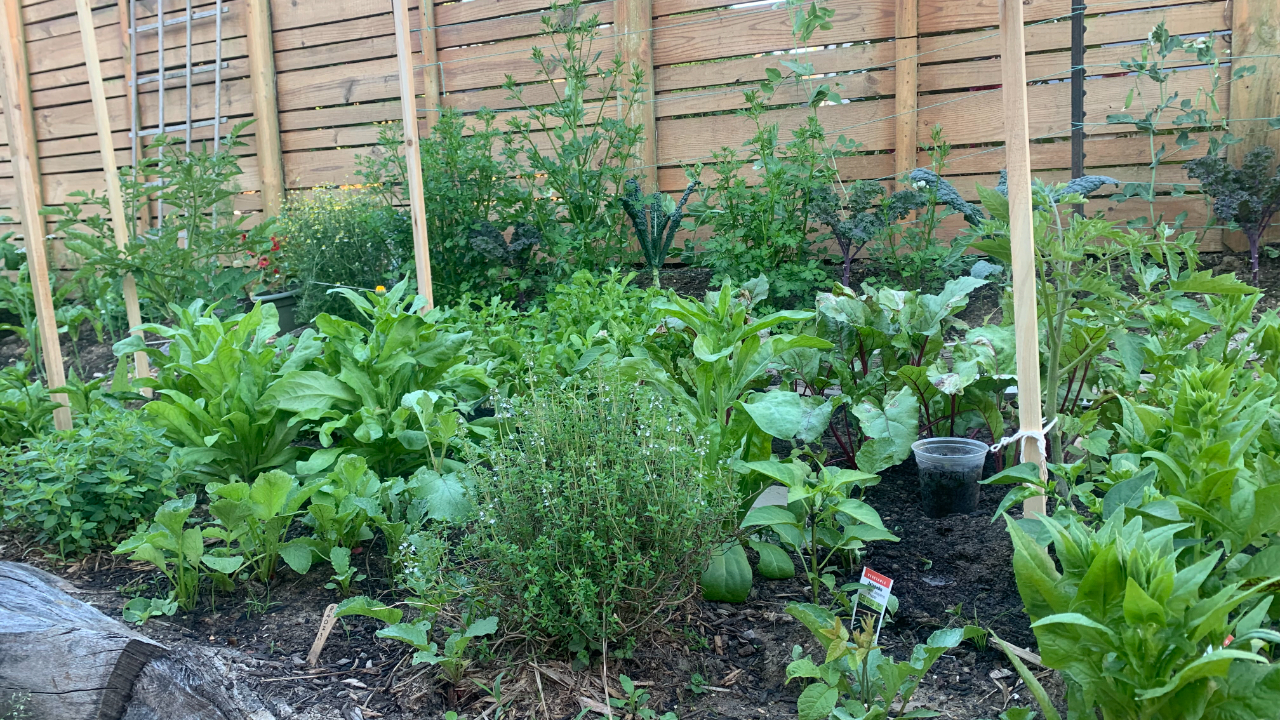
I learned this not from a textbook. I learned it from soil.
There is no way I could have managed what I'm building in my garden now in year one. I didn't have the skills, the knowledge, the physical stamina, or the systems for it. I started with herbs in pots. I learned what I could sustain. Then I added something else. Each layer built my capacity for the next one.
You don't force a plant to perform on your timeline. You learn what conditions it actually thrives in and you create those conditions. You don't dump fertilizer on depleted compacted soil and expect it to suddenly produce. Too much input too fast overwhelms the ecology. Slow integration is not weakness — it's how things actually take root.
A burned forest doesn't jump back to a canopy. It goes through succession — pioneer species first, then shrubs, then understory, then canopy. Each stage creates the conditions for the next. You cannot skip to the canopy. And you wouldn't want to, because the canopy is only possible because of everything that came before it.
Your body works the same way.
Stabilization means gradually increasing your capacity to tolerate variation without crashing. Restoring digestive function. Re-establishing rhythm. Reducing conflicting inputs. It's not doing nothing — it's building the adaptive capacity that makes everything else possible.
The last couple of years I wasn't optimizing. I was stabilizing. My finances, my nervous system, my home, my daily rhythms, my sense of what I could trust. My garden. My capacity to show up without running on empty.
It was slow. It wasn't always exciting. And now — creativity is returning. Future orientation is returning. The desire to build and expand. Not because I forced it. Because I stabilized the terrain enough that the organism could reallocate energy away from pure survival.
That's the whole point. Conditions, not commands.
Where to Start
You're not broken. If things haven't been working the way you hoped, it's very likely your system hasn't been in a state to receive what you've been giving it. That's not a character flaw. That's physiology.
The question isn't what else should I add. The question is — what's one layer of pressure I could reduce this week? Not everything. Just one thing. Sleep. Minerals. A rhythm you can actually sustain. An input you could remove that your system is spending energy trying to process.
Start there. Let that land. See what opens up.
If you don't know where to start — if you're overwhelmed by everything out there, or you've exhausted yourself trying all the things, or you've run the tests and don't know what to do with them — this is the work I do inside Minerals & Microbes.
I walk beside you for four months to help you stabilize. We use Hair Tissue Mineral Analysis and BiomeFX to see what's actually happening in your terrain, and we build support that matches what your body can genuinely receive right now.
Learn more about Minerals & Microbes here.
Stay empowered with my weekly updates!
If you enjoy reading my posts, please consider being a part of the tribe that is being built here. You're information will not be shared.
